1. Operation
LAM Son 228 – [unclear] Jun 68 to 111800 Jun 68.
2. Location
Reference – Map, N? 1:50,000 Sheet 642 [unclear].
3. Mission
Find, engage, and destroy NVA elements presently infiltrating 2d ARVN Regiment’s northern TAOR.
4. Supporting Forces
A. Headquarters and Headquarters Battery, Battery A, and Battery B of 1st Battalion (SP), 4th Artillery.
B. 2d ARVN Regiment, 1st ARVN Division.
C. 3d Battalion, 3d Marine Regiment, 3d Marine Division.
5. Intelligence
A. Enemy Units: Unknown elements of 320th NVA Regiment.
B. Situation in the Objective Area: Approximately ten-day-old elements of the 320th NVA Regiment located in the vicinity of the [unclear] area. DMZ, [unclear] reinforcements and supplies were moving through the area. Local villages have gone to NVA forces located within the objective area.
6. Description of Local Terrain
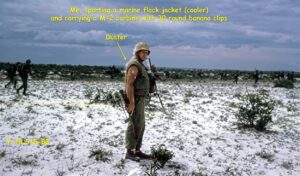
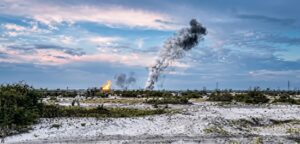
Separated villages located in sparse tree lines surrounded by large open sandy areas and dried rice paddies.
7. Concept of Operations
On 060700 Jun 68 the 2d ARVN Regiment will proceed from C-1 to the north and secure objectives 1 and 2 by 1100 hours. All ARVN forces with 4th Battalion, 2d ARVN Regiment will proceed from C-1 to secure objective 3, and establish a blocking force east of the objective. On call and if artillery strikes will be initiated once contact is made.
8. Execution
On 060900 Jun 68 three M42s and 4/1/44 were supporting elements from 1/4/44 departed Dong Ha and joined the 1st Battalion, 2d ARVN Regiment at checkpoint 2, proceeded between objectives P and Q and continued to an objective. A 20-minute helicopter search was conducted and thoroughly searched with no contact.
Proceeding north to objective E, one M42/4/44 was disabled by a mine. No casualties were incurred. Perimeter security was established while a VTR [unclear] recovered the M42.
Continuing the Operation
Continuing the operation and advancing approximately 230 meters, another M42/4/44 was disabled by a mine resulting in two WIA [NON-MEDEVAC].
Continuing the operation and advancing approximately 200 meters, another M42/4/44 was disabled by a mine resulting in two WIA [NON-MEDEVAC].
As the VTR was unavailable and darkness was imminent, hasty field expedient recovery was made. While repairs were in progress, NVA artillery adjusted on the M42s’ positions. Proceeding with minimal speed and disregarding the hostile artillery, the crews completed the necessary repairs. As the M42s moved out of the area, several volleys of NVA artillery impacted where the M42s had been only moments before.
Lacking mine-sweep equipment and suspecting the presence of additional mines, the M42s were extracted and regrouped at C-1 at 1900 hours. With the disabled M42s, 1st Battalion and 4/1/44 elements proceeded toward the area. During and under full moon, traveling with lights on, all 20-ton forces in the convoy were halted. Establishing flank security on each side of the route, a search of the immediate area was conducted with negative results. Using the M42s to level the ground, sufficient bypass was made which enabled the M42s and vehicles to skirt the obstruction. All elements reached C-1 at 2300 hours.
On 091200 Jun 68 all elements, traveling the same route as the previous day, again joined the same ARVN forces at objective E. Later that morning the ARVN had passed the objective during the NVA’s attack. Elements of the force faced individual fighting that took place under a heavy volume of NVA artillery fire. The intense enemy small-arms and automatic weapons fire was immediately directed at the M42s as they deployed on line to provide suppressive and covering fire for the ARVN infantry. While systematically destroying the enemy positions, M42 personnel inflicted 3 WIA requiring MEDEVAC and 1 KIA from small arms fire from the enemy. As hostile artillery adjusted, the M42s pulled back 500 meters from the enemy positions, impacting on the positions occupied only moments before. As the M42s continued their supporting role, they were again hit with enemy artillery. The M42s moved out of the area and returned to C-1.
On 111200 Jun 68 four M42s and supporting vehicles, traveling the same route secured the previous days, joined the 1st and 2d Battalions, 2d ARVN Regiment and an ARVN APC company at objective F, taken on 10 Jun 68. The remaining NVA elements, a reinforced company, were trapped in the vicinity of checkpoint 20. The concept of operations was:
(1) USAF elements conducting a blocking force east of the river.
(2) The 4th Battalion, 2d ARVN Regiment providing a blocking force extending from objective C to the river.
(3) The 2d Battalion, 2d ARVN Regiment and the APC company proceeding on the right flank along the river through checkpoint 21.
(4) The 1st Battalion, 2d ARVN Regiment supported by the M42s proceeding on the left flank directly to checkpoint 20.
Initially, air and artillery strikes saturated the enemy positions. At 1500 hours the assault began when the 2d Battalion and APCs encountered fierce resistance on the right flank after moving only 500 meters where they were halted by the heavy volume of enemy automatic weapons and artillery fire. The initial contact resulted in the infantry and APCs withdrawing approximately 300 meters. The ARVN Battalion Commander and two ARVN company commanders, and the American advisor, hearing the ARVN units’ disorganized and virtually without command, launched in turn and took the lead in the disposition. The NVA artillery, now located and under counter-battery and naval gunfire, continued to fire on the 1st Battalion and the M42s, causing a constant changing of positions. The NVA, seizing the opportunity, counter-attacked. The fact that a counter-attack in progress was not readily apparent. Completely and deliberately camouflage was utilized as bushes and stacks of straw, the NVA force was not visible until it crossed open flat areas immediately to the front of the M42 elements. The NVA attack continued to within 100 meters of the M42s when their fire destroyed the force. The NVA were now attacking from all sides and army. At 1800 hours the M42s were extracted and all elements returned to Dong Ha.
9. Results
A. 219 NVA KIA (confirmed) and 2 NVA POW.
B. 2 U.S. KIA and
6 U.S. WIA [MEDEVAC], 29 ARVN KIA and 53 ARVN WIA.
C. 46 individual weapons, 2 crew-served weapons, and 60 tons assorted ammunition were recovered.
D. Expended 1870 rounds 40mm ammunition.